
Many people ask me about social entrepreneurship, when they read my CV and resume. It really isn’t something, You are reading or hearing about everyday.
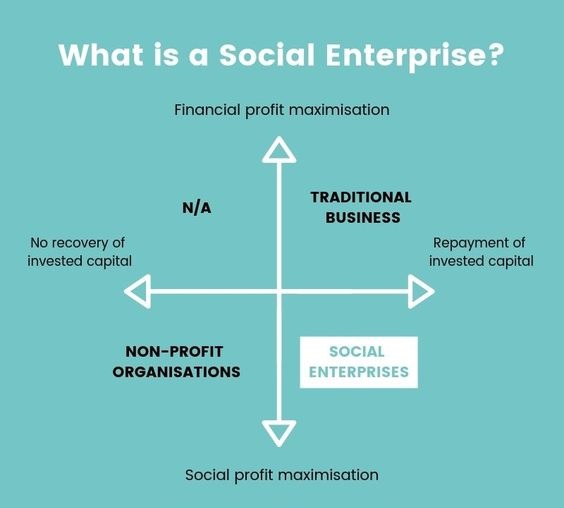
So what does social entrepreneurship mean? This is an activity that aims to solve or smooth out social problems. The concept of social entrepreneurship is now legally formalized, and the areas of activity are expanding. But, as before, the main feature of such commerce is the direction of profits on social improvements.
Who is a social entrepreneur?
A social entrepreneur is a small or medium-sized business entity that forms a special business model. It should be aimed not only at achieving commercial success, but also at helping socially vulnerable and poor citizens, solving significant social problems. This may be the production of goods or the provision of services, the creation of preferential jobs, environmental protection.
We can say that a socially significant business stands on five “pillars”:
- Goal. The task of such a merchant is to mitigate its effect.
- Social result. Not abstract, but measurable and positive.
- Innovative methods. To achieve the goals, new approaches are needed to invest in the enterprise.
- Financial stability and project payback. Infusions from the outside cannot be endless. Even a complete government will end sooner or later. A social enterprise should reach self-sufficiency.
- Possibility of expansion. This should be large-scale – both structurally and through the dissemination of experience. Several socially significant enterprises are always better than one.
An independent entrepreneur must engage in commercial activities. He should focus on resources and forces to achieve goals, to act non-standard in life situations. Projects must be predicted, the future depends on the success of the enterprise.
What is related to social entrepreneurship?
Social entrepreneurship is pure or with corporate social responsibility. In the first case, all the profits go to help those in need. Profit from a business depends only on income.
The categories of people whom social businessmen provide assistance include:
- disabled people;
- orphans and graduates of orphanages;
- single moms with children up to seven years old;
- large families;
- pensioners;
- former prisoners.
- people who accidentally find themselves in a difficult life situation can fall into this category.
The activities of entrepreneurs affect the sectors of health care, physical education, tourism, social services, employment, and cultural education. It can also be assistance to victims of natural and man-made disasters, armed conflicts, violence.
FACT! The concept of public entrepreneurship has not yet been clearly defined by law.
In Slovakia, parliament adopted the corresponding bill in the first reading. This act outlines how the legal regulation of socially significant commercial activity will take place. Currently, there are only small and medium-sized businesses operating in the field of services for people with disabilities, large families and other low-security citizens. However, social business can cover various areas – from the entertainment and cultural field to environmental protection.
Examples of social entrepreneurship in Slovakia
Domestic social people are actively developing the topic of employment of socially vulnerable people. Most of the projects mentioned below are competitors of Social Impact Award Slovakia. Vivid examples of successful projects in this area are:
- Quake resQ. Project, that I was member of. Our ultimate goal was to save people, who live in zones endangered by earthquakes. We developed system, that warns people about earthquake shakes before they happen, and tells them what to do in this case. System is also connected with household control panel, and can turn off all electronic appliances in the case of emergency. This project was winner of Social Impact Award 2015.
- LeapKin. Slovakia has not very well built sanitary infrastructure for disabled people, and therefore they have often to travel abroad for medical and rehabilitation stays. Project LeapKin aims exactly on these people. They developed amazing games, that help disabled people to recovery much faster. In addition, thanks to LeapKin, disabled people can find and make new friends.
- Octago. Roughly 20% of Slovak citizen suffer from obesity. There is no other possibility to prevent overweight, than exercising. Octago is a team of young people, who like sport, especially calisthenics. Their passion lead them to building playgrounds for body-weight training. Until today, they built more than 55 workout parks, and won tens of awards.
- ChemPlay. Whether You like chemistry or not, You have to agree, that it is very difficult, and sometimes also boring subject. Fortunately, not always. With simple, yet addictive board game created by ChemPlay, You will absolutely love chemistry. Believe me, I played this game for 1…2…3…6 hours!
Perhaps the most famous social entrepreneur in the world, billionaire Ruben Vardanyan believes that projects that improve the life of society in the long term will be most in demand at present. Since they are unprofitable and require a strategic approach, government and corporate assistance is needed for such businessmen.
You can watch lectures by Ruben Vardanyan on social entrepreneurship on video (Russian):
Business Ideas for Future Social Entrepreneurs
Not all of these business ideas can be realized right now, but, perhaps, with increased support for social entrepreneurship, they can be realized. And some are already successfully operating in ourcities. Interesting options include:
- Opening a store with maximum discounts on essential goods.
- Transfer of textbooks and books to the needy from former students.
- Interest-free microcredit.
- A restaurant where those in need are fed for free at the expense of wealthy visitors.
- Social fitness clubs with professional trainers.
- Teaching circles for children from families who cannot pay to tutors.
- Retraining courses for professions for people with disabilities.
- Visiting mini-ateliers and hairdressers for those who find it difficult to leave home.
- Production and installation of alternative energy devices for the development of remote regions.
New cleaning organizations, boarding houses for seriously ill and elderly people, social companies providing services of nannies and nurses are already opening.
But time-tested projects, too, should not be forgotten. Even in Slovakia, factories, where people with disabilities worked, are very successful. They made cardboard containers, sockets, sewed clothes. If you organize such enterprises and equip them with modern machines, this will not only give jobs to people with disabilities, but also facilitate their work.

Types of Social Entrepreneurship Activities
The traditional model of social entrepreneurship is charity. These are social shops, auctions, fairs, gatherings, concerts. The proceeds received at the event are sent to a charity fund.
But there are other business models that are successfully operating in this industry. Just look at the options for different types of activities with examples, mostly from Russia:
Social business Real implementation
Help finding a job. It is especially needed for people with disabilities, people of pre-retirement age, young people with no experience, former alcoholics and drug addicts, as well as those released from places of detention. Eugene Rapoport founded the project "A string bag gives hope." Its essence is that people with disabilities create beautiful woven bags that quickly sell out. In addition to employing disabled people, this activity is aimed at preserving the environment from littering with plastic. The idea brought victory to the author, as the best social entrepreneur, in the Russian contest "I am an active citizen."
Sale of goods at an affordable price or free of provision services. The latter model is even more necessary, since people who find themselves in a difficult situation, moral support is very important. GAOORDI - The Association of Parents of Children with Disabilities has created the “Respect +” project. Its essence is in providing relaxation, time to take care of those moms and dads who raise children with severe pathologies.
Availability of necessary goods and services. In this case, the merchant fills empty market niches, giving consumers the opportunity to receive the necessary goods and services that they are deprived of. The LavkaLavka farming cooperative has created an Internet portal, thanks to which agricultural producers from remote farms can find people who want to buy fresh food from them without antibiotics and pesticides. The order is made through the network, and the products are delivered to the home of the buyer.
The development of dying territories with the involvement of the remaining local population. A successful enterprise will provide work not only for the village, but will also attract new specialists to the remote corners. In the taiga outback - the village of Small Turtysh, located more than two hundred kilometers of Yekaterinburg, a unique factory for the production of cream honey was opened. The creators of the Cocco Bello project, Guzel and Ravil Sanzhapovs, have recruited local senior citizens, and the company is developing successfully.
Creation of platforms for social entrepreneurship. Such platforms for trading and exchange of experience can operate both online and offline. The Affiliate House “More Than a Buy!” Supports social businessmen, helping them boost sales, compose an assortment line, and place a line of products in chain stores without paying rent.
The second life of things. There is an organization of collection of old, but still suitable things that are put in order and distributed to those who need them. Charity store “Thank you!” was opened without initial funds, on one initiative. Its organizers packed and distributed stuff to the poor. Now it is already a corporation with an established scheme for the collection and distribution of clothing.
These are far from all the options that are now being implemented in different parts of the world. Thanks to social entrepreneurs, many who have already bowed their heads feel the joy of life. And the matter is not only in material means. Sometimes human participation and time spent is even more valuable.
Support measures
The undertakings of social entrepreneurs find responses in the hearts of not only businessmen, but also of deputies and officials. After all, the attitude of the population towards power structures is correlated with attention to social problems and assistance to unprotected layers. Presumably, with each year state support to merchants engaged in socially useful activities will increase. But already now there are programs that contribute to the development of this business area.
-
Social Entrepreneurship Subsidy
Subsidies for the implementation of projects of socially significant business are given free of charge and irrevocably within the framework of the Federal Program for the Support of Small and Medium Enterprises. They can be spent on the development of a social enterprise. The maximum how much an entrepreneur can get is different in each and every country. However, the businessman must win the competition and invest himself at least 15 percent of the funds provided.
-
Business Assistance Organizations and Funds
In most regions, an entrepreneur can find support at the Social Innovation Center. Contact details for a local organization are easily found through the SME Business Navigator.
At CISS, a novice businessman can count on the support of lawyers and analysts, obtain reliable information to solve pressing problems, and consult on issues in the field of accounting, taxation and marketing promotion.
Also, assistance to representatives of social commerce is provided by:
- Social Project Support Fund. It offers free training, advice to successful businessmen and assistance in obtaining financial benefits. The activity of the applied businessman should relate to the fields of health care, education and child development, physical education and sports, support for the elderly and disabled, ecology, culture.
- Foundation for Regional Social Programs “Our Future”. It provides assistance to small businesses whose work contributes to the solution of social problems. The main activities of entrepreneurs are geriatrics, job search, ecology and social tourism, production of socially significant products, development and leisure of children. Thanks to the fund, you can get a loan on favorable terms, but the entrepreneur himself must invest in the project at least 20 percent of the loan amount. When choosing borrowers, a non-standard approach to solving the problem is welcome.
You can also take part in the annual All-Russian contest “The Best Social Project of the Year”. Its winners will receive not only prizes and diplomas: their projects will be promoted in the regions on the most favorable terms.
TIP! If a social enterprise is actively developing, its founders should join the Register of Social Service Providers.
According to Law, its participants are compensated for the costs of providing social services from the federal budget. The Tax Code of Slovak Republic establishes a zero rate on income taxes and exempts from VAT if the company is in this register.
Support for beginning social businessmen is provided not only by government agencies, but also by large enterprises. Options for such assistance: consulting services free of charge, legal support, the provision of premises. Corporations themselves promote social assistance for their own employees – organizing leisure activities, placing children in kindergartens, allocating vouchers to motels and summer camps.
Social entrepreneurship is beneficial not only to society. A businessman engaged in such an important business feels his importance. In addition, no one says that you need to give the last shirt. With the right approach, the founder of the business will not lose the money.
Business models of social entrepreneurship with practical examples are show in the video (Russian):
Awesome post! Keep up the great work! 🙂
Great content! Super high-quality! Keep it up! 🙂